Outings - Summer 2015
|
|
Ranmoor Ringers Outing to York | |
|
Saturday 18th July 2015 |
While sitting in the |
|
|
St
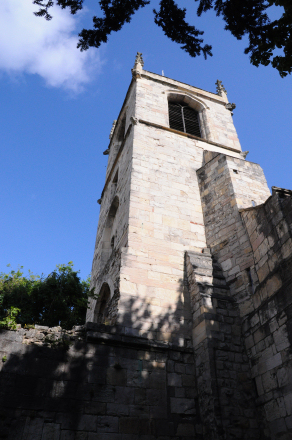
Olaves, Marygate, York, 6, 9-0-14 in G Grid Ref SE598521 Lat, Long 53.96222, -1.08925 Postcode YO30 7WH 10:15 - 11:00 St Olave is dedicated to St Olaf the patron saint of Our band of ten arrived punctually to ring at 10.15 with no one to welcome us. Apparently our host was shopping and thought it was 10.30. Whilst waiting, we explored the surrounds of the church which set off alarms, and a tannoy with siren stating we had been filmed and police arrival was imminent. Our host informed us that the alarm was always being set off by the wind and in true British style nothing happened. The ropes were lowered, bells rung up in peal and a very enjoyable session commenced. Rounds, changes and methods were rung, watched by a number of tourists and passers by, as the bells were rung from the church floor; a beautiful church well worth a visit. The church backed on to the museum gardens, which was our route to the next ringing destination. |
|
|
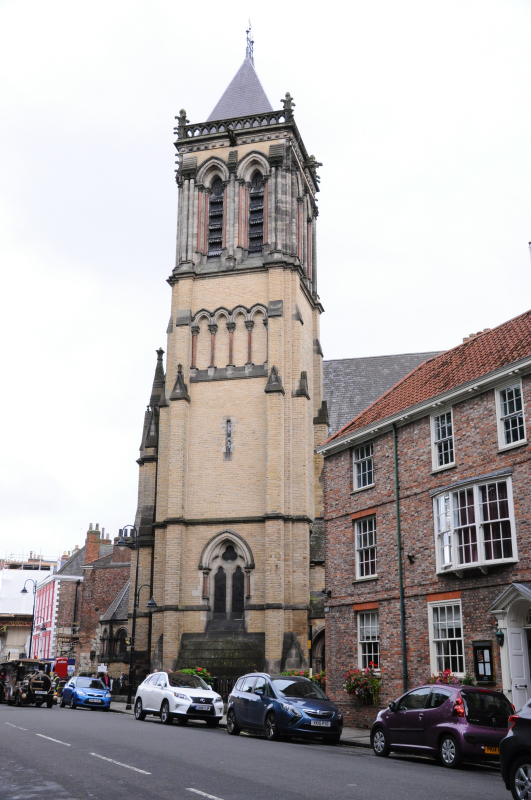
St Wilfreds, Duncombe Place, York, 10, 18-1-21 in F Grid Ref SE601521 Lat, Long 53.96179, -1.08462 Postcode YO1 7HE 11:15 - 12:00 St Wilfred's is built in the Gothic revival manner, (I prefer the term Gas Pipe Gothic), and completed in 1864. The church was built to be a Catholic Cathedral and has a completely different feel to that of St Olave. The tower is 147ft high and when walking up from the bridge it appears to dominate the Minster. There are ten bells which were added to the tower in 1995. We were met on time by the tower captain and asked to ring for an extra 15 minutes to call the worshipers to mass. The belfry is approached up a spiral stone stair, or is it a helical stair? The belfry is slightly larger than Ranmoor and the ring, though heavier, is very similar and enjoyable to ring. Changes and methods were rung after which we all went our separate ways for lunch, to rendezvous for |
|
| Lunch | |
|
|
All Saints,
North Street,
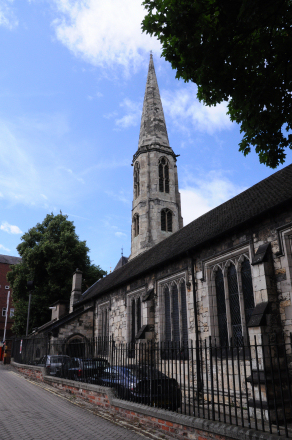
York, 8, 7-2-2 in A Grid Ref SE600517 Lat, Long 53.95839, -1.08646 Postcode YO1 6JD 13:15 - 14:00 All Saints is located next to the Ouse and was founded in the 11th Century, the present building being from the fourteenth and fifteenth centuries. The most impressive external feature is the octagonal tower, and internally the medieval glass windows, one of which depicts the fifteen signs of the end of the world. On arrival the church seemed to be in some disarray with an archaeological dig to one side, clergy bustling around preparing for the mass, and three members of the choir practising under the ropes. We were met by the tower captain who explained some of the quirks of the eight bells, the choir was moved and the ropes lowered, bells rung up in peal and ringing commenced with rounds, call changes and methods. With the two external doors open, creating a throughway to the dig, the bells being rung from the church floor for the mass, completely open to the congregation, and a number of bystanders watching us ring, it was all a little confusing. Becky then led us to her home tower, passing the former church of |
|
|
St
Lawrence, Lawrence Road /
Hesslington road, York,
8, 7-3-24 in A
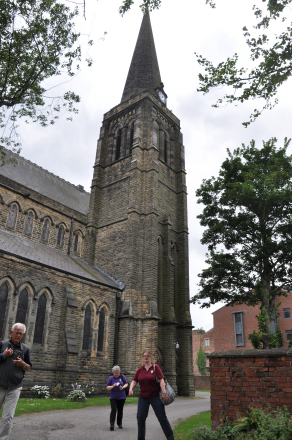
Grid Ref SE611512 Lat, Long 53.95386, -1.06908 Postcode YO10 3BN 14:45 - 15:45 The original church of St Lawrence was badly damaged in the siege of York, rebuilt in the restoration, finally demolished in 1881/3 and re built by Victorian architect J B Hall of Canterbury. It is the second largest church in Climbing up a tight stone stair one accesses a compact carpeted ringing chamber. Each window in the tower has a deep reveal with a low cill allowing ringers to sit out, very useful after our long walk. We were confronted by the 1737 bell, which used to hang in the tower of the old church. The ropes were dropped, bells rung up in peal, rounds, call changes and methods; a very satisfying ring. |
|
|
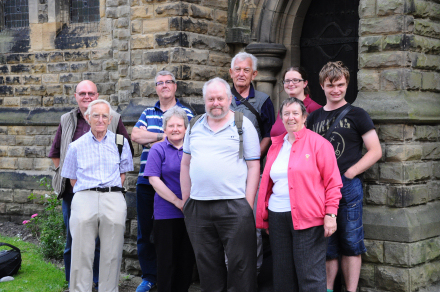
Before
departing for home and going our separate
ways, a
group photo was taken. For me, it was a most enjoyable
and privileged day, to ring
at four such diverse and interesting historic towers. Thank you to Gill
for being our
leader and organising the
day so efficiently. Attending band members – Rebecca Holloway, Janet Else, Richard Noble, Will Rumsey, Leslie Middleton, Nick Harrison, Gillian Platt-Hopkin, Robert Guttridge, Ben Newsam and David Williams. Robert Guttridge July 2015 |
|
| |
Location information from Dove's online Guide (http://dove.cccbr.org.uk) |
| Back to Outings Index |
| Back to News Index |
| Go back to Homepage |